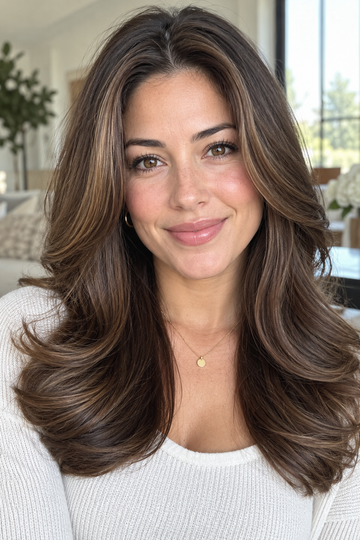
The Anatomy of a Blowout: How to Achieve a Salon-Worthy Finish at Home
Here is a guide to deconstructing the salon blowout—breaking down the physics, the tools, and the techniques—so you can replicate that bouncy, glassy finish at home.
Phase 1: The Foundation (Preparation)
Salons don’t just wash hair; they prime it. A true blowout is 80% preparation, 20% styling.
1. The Clarifying Reset
Product buildup is the enemy of volume. If you use dry shampoo, serums, or hard water, start with a clarifying shampoo. This strips away residue that weighs hair down, allowing the cuticle to actually close smoothly later. Follow with a lightweight, hydrating conditioner only on the mid-lengths to ends. Avoid heavy masks before a blowout—they make hair too soft to hold a curl.
2. The Microfiber Towel
Rubbing hair with a terry cloth towel causes friction, lifting the cuticle and creating frizz. Instead, squeeze excess water out in a microfiber towel or an old cotton t-shirt. You want hair to be 80% dry before you pick up a brush. Damp hair is malleable; wet hair is too heavy to lift, and water turns to steam that can damage the cuticle if you apply high heat too soon.
3. The Primer
Just as you wouldn’t paint a wall without primer, you cannot skip thermal protectant. Use a blow-dry cream or heat protectant spray. For fine hair, use a volumizing mousse at the roots before drying. This creates "grip," giving the hair the texture it needs to hold a round-brush curl.
Phase 2: The Tools of the Trade
Salon results require professional-grade tools. Your grandmother’s Conair from 1995 won’t cut it.
- The Dryer: You need an ionic dryer with at least 1800–2000 watts. Ionic technology breaks down water molecules faster and closes the cuticle, resulting in shine. The nozzle (concentrator) is non-negotiable; it focuses the air, preventing frizz and allowing you to direct the cuticle where you want it.
- The Brush: This is more important than the dryer.
- For Volume: A round ceramic or tourmaline brush. The ceramic heats up, acting like a curling iron to set the style. The barrel size dictates the result: large barrel (3–4 inches) for volume and smoothness; small barrel (1–2 inches) for defined curls and bounce.
- For Smoothing/Fine Hair: A paddle brush with boar bristles. Boar bristles distribute the scalp’s natural oils (sebum) down the shaft, creating that "glass hair" shine.
Phase 3: The Technique (Sectioning & Tension)
Salons look effortless because stylists work in sections. If you try to dry your whole head at once, you’ll get poof, not polish.
1. Rough Dry
Remove the nozzle. Rough dry the hair until it is about 70-80% dry. Focus on the roots first; if you start with the ends, the roots will air-dry flat. You want the roots completely dry before you start using the round brush—this is the secret to lasting volume.
2. Sectioning
Clip the hair into four quadrants: top crown, left, right, and nape. Work from the bottom up. If you start with the top, you’ll just knock it down while reaching for the underlayers.
3. The Pull & Twist (The "Salon Move")
Take a section no wider than the width of your brush.
- Tension: Hold the brush underneath the section. Use the dryer (with nozzle attached) to follow the brush. The secret to smoothness is tension. Pull the hair taut away from the scalp. If the brush isn’t pulling tight, you’re just waving hot air at it.
- The Cool Shot: Most people ignore the button on the dryer. After you’ve applied heat to a section, hit it with the cool shot for 5 seconds while the hair is still wrapped around the brush. This "locks" the cuticle into place, setting the shape and sealing in shine.
Phase 4: The Finish (Sealing & Locking)
You’ve dried the hair, but the blowout isn’t over until the hair is room temperature.
1. The Cooldown
If you drop a section while it is still warm, gravity will win. After you release the brush, let the section hang. Do not touch it, brush it, or run your fingers through it until it is completely cool. Hair is like memory foam: it remembers the shape it was in when it cooled down.
2. The Pin-Curl Set (Optional, but Elite)
For volume that lasts 3–4 days, stylists will often roll the finished section back up into a large Velcro roller or pin curl while it’s still warm from the brush. They finish the entire head, then spray with hairspray, and let the client sit under the dryer or finish makeup. By the time you release the curls, the volume is architectural.
3. The Product "Sandwich"
To avoid greasy or crunchy hair:
- Pre-dry: Mousse or Volumizer.
- Mid-dry: Heat protectant cream.
- Post-dry: Dry Texture Spray at the roots for grip (absorbs oil and lifts) and a single pump of Lightweight Hair Oil on the mid-lengths to ends to break up any stiffness and add that "glass hair" shine.
Troubleshooting Common Issues
- "My arms get too tired to finish."
You are likely using too much water or too big of a section. If you are holding the dryer for more than 60 seconds on one section, the section is too big. Smaller sections dry faster and smoother. - "I get frizz as soon as I step outside."
You are missing the cool shot. If you apply heat and then immediately release the section into humid air, the cuticle pops open. The cool shot seals it shut. - "The curls fall out immediately."
This is a tension issue. If the hair isn’t wrapped tightly around the brush with a 90-degree angle of tension away from the scalp, you aren’t actually bending the disulfide bonds in the hair. Also, ensure your hair is bone dry; any moisture left in the core will steam out the curl.
The Verdict
The difference between a home blowout and a salon blowout is rarely talent—it is patience. Salons achieve the finish because they take the time to work in micro-sections, use extreme tension, and allow the hair to cool in the shape they want it to hold.
Pro Tip: If you want to extend the life of your blowout, sleep with your hair in a loose, high ponytail (a "pineapple") on a silk pillowcase. In the morning, use dry shampoo before you get oily, and only use the flat iron to polish the face-framing pieces—never re-brush the entire head, as that reintroduces frizz.